

Our Research
Computational materials research is firing on all cylinders, driving the discovery of new materials well beyond the computational realm! In our lab, our research spans three main branches: modeling and simulation, software and hardware development, and wet-lab synthesis and characterization.
- Modeling & Simulation. Students build a foundation in math, physics, and chemistry to understand how reaction mechanisms can be described and designed, while also developing basic programming skills to create and use tools for identifying reactions and modeling materials. Our simulation research projects are often in collaboration with experimental groups, such as the Humphrey Group (inorganic chemistry), the Hull Group (organic chemistry), the Ren Group (electrochemistry), and the Zheng Group in Chemical Engineering. The research topics revolve around catalysis and battery material designs, such as studying catalysts for methane activation, hydrogen evolution reactions, proton/zinc/lithium batteries. These projects explore topics such as catalysis and battery materials, including catalysts for methane activation and hydrogen evolution reactions, as well as proton, zinc, and lithium batteries.
- Software & Hardware Development. This branch focuses on creating new tools that use machine learning potentials to accelerate materials research. One of our starting projects is the “Feel the Force” haptic device, which translates the forces acting on an atom into physical feedback, allowing researchers to actually feel where atoms are being tugged and pulled. Researchers can then use their chemical intuition to guide atoms and explore reaction landscapes that may be difficult for algorithms to navigate efficiently. Our research aims to make molecular systems more tangible by developing a haptic device designed specifically for materials scientists. Our team is building the device from the ground up to create a new, more intuitive way to interact with and explore molecular systems.
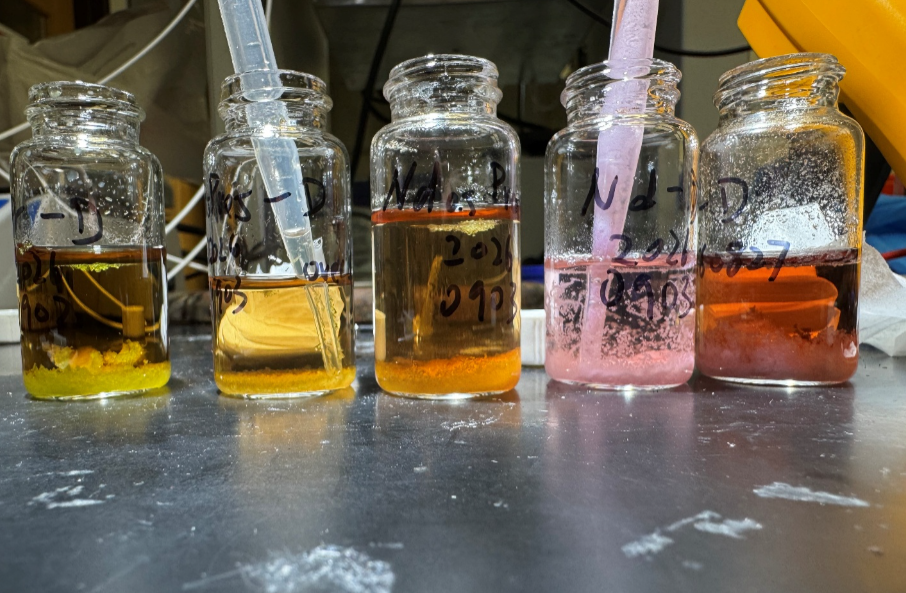
- Wet-lab Synthesis & Characterization. Here is where computation meets experiment! We take ideas generated through our simulations and put them to the test, designing new materials and exploring synthesis methods, particularly through electrochemistry. Our work tackles challenging problems such as lithium extraction and rare-earth element separation, using advanced techniques including cyclic voltammetry, X-ray diffraction, and X-ray photoelectron spectroscopy. This gives students the opportunity to move between predicting how materials should behave and discovering how they actually behave in the lab.

Our Strategy
Our strategy is to build a strong interdisciplinary foundation and then give students the flexibility to develop in the direction that best fits their interests. Students begin with the fundamentals of math, chemistry, physics, and computer science while building practical skills in Python and Linux bash scripting, with opportunities to learn specialized languages such as FORTRAN.
As students gain experience, they can shape their own research path, whether developing computational solutions for experimental researchers, building new tools for materials scientists, or combining computation and experiment to approach materials research from both sides.

Our Impact
Our Team
Wenrui Chai
- Assistant Professor of Practice
Graeme Henkelman
- Professor
- George W. Watt Centennial Professor
Resources
Course Credit
Research Outcomes
- Oxidation of Sn at the Cluster–Support Interface: Sn and Pt–Sn Clusters on TiO2(110)
- Growth of Uniquely Small Tin Clusters on Highly Oriented Pyrolytic Graphite
- H-bonded organic frameworks as ultrasound-programmable delivery platform
- Organoarsine Metal–Organic Framework as a Solid-State Ligand for Rhodium(I) Olefin Hydroformylation Catalysis
- Chain-length-selective adsorption governs diffusion-limited dendrite growth mode in battery electrodes